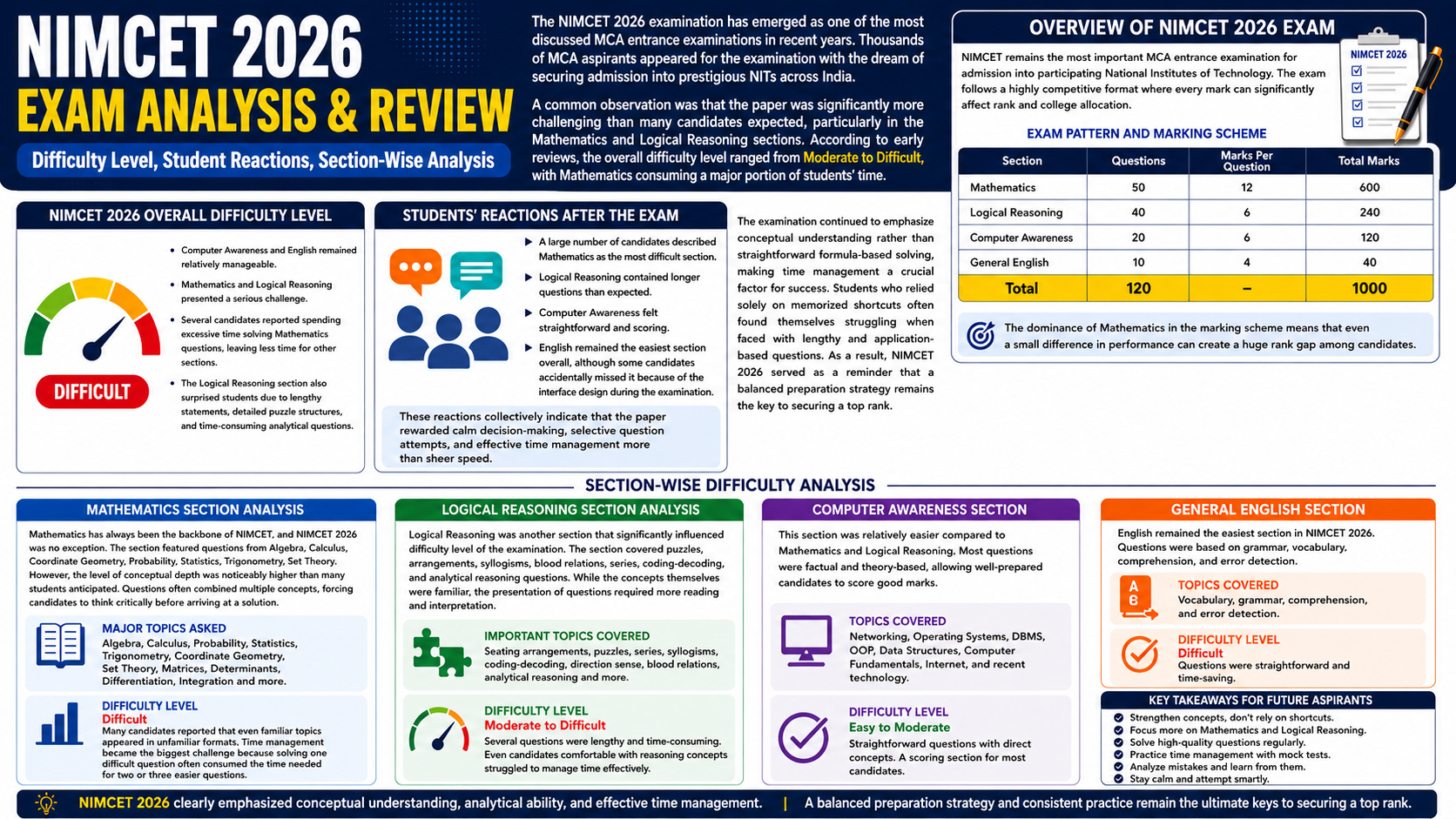
The NIMCET 2026 examination has emerged as one of the most discussed MCA entrance examinations in recent years. Thousands of MCA aspirants appeared for the examination with the dream of securing admission into prestigious NITs across India. A common observation was that the paper was significantly more challenging than many candidates expected, particularly in the Mathematics and Logical Reasoning sections. According to early paper the overall difficulty level ranged from Moderate to Difficult, with Mathematics consuming a major portion of students' time. The examination continued to emphasize conceptual understanding rather than straightforward formula-based solving, making time management a crucial factor for success. Students who relied solely on memorized shortcuts often found themselves struggling when faced with lengthy and application-based questions. As a result, NIMCET 2026 served as a reminder that a balanced preparation strategy remains the key to securing a top rank.
Overview of NIMCET 2026 Exam
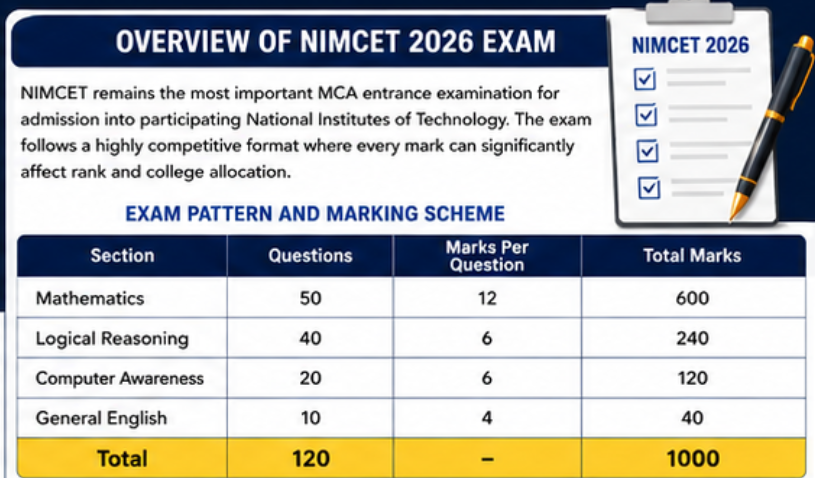
NIMCET remains the most important MCA entrance examination for admission into participating National Institutes of Technology. The exam follows a highly competitive format where every mark can significantly affect rank and college allocation.
Exam Pattern and Marking Scheme
Section | Questions | Marks Per Question | Total Marks |
Mathematics | 50 | 12 | 600 |
Logical Reasoning | 40 | 6 | 240 |
Computer Awareness | 20 | 6 | 120 |
General English | 10 | 4 | 40 |
Total | 120 | - | 1000 |
The dominance of Mathematics in the marking scheme means that even a small difference in performance can create a huge rank gap among candidates. This was clearly reflected in NIMCET 2026 where Mathematics became the deciding factor for many aspirants.
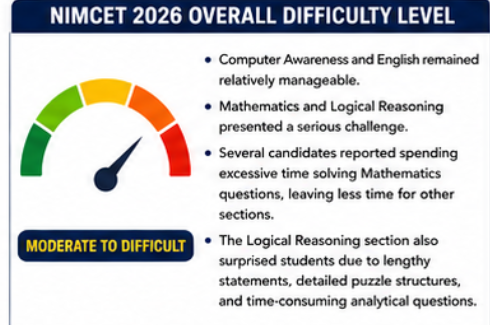
NIMCET 2026 Overall Difficulty Level
The overall difficulty level of NIMCET 2026 can be categorized as Moderate to Difficult.
· Computer Awareness and English remained relatively manageable,
· Mathematics and Logical Reasoning presented a serious challenge.
· Several candidates reported spending excessive time solving Mathematics questions, leaving less time for other sections.
· The Logical Reasoning section also surprised students due to lengthy statements, detailed puzzle structures, and time-consuming analytical questions.
Many student revealed that even well-prepared aspirants struggled to complete their targeted attempts. Many candidates who had comfortably solved previous-year papers found the 2026 paper noticeably tougher. This suggests that the examination authority focused more on testing analytical thinking rather than routine problem-solving skills. Such a shift often leads to lower average scores and potentially lower cutoffs compared to easier examination years.
Students' Reactions After the Exam
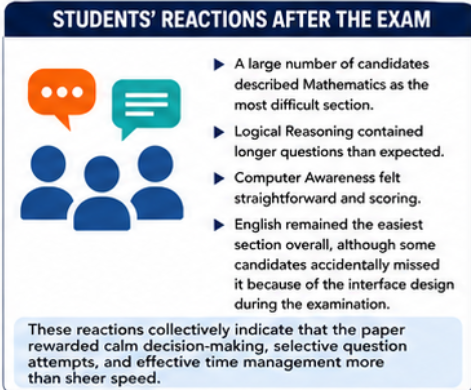
Student reactions provide valuable insight into the real examination experience. A large number of candidates described Mathematics as the most difficult section. Others noted that Logical Reasoning contained longer questions than expected. Several students also mentioned that Computer Awareness felt straightforward and scoring. English remained the easiest section overall, although some candidates accidentally missed it because of the interface design during the examination. These reactions collectively indicate that the paper rewarded calm decision-making, selective question attempts, and effective time management more than sheer speed.
Section-Wise Difficulty Analysis
Mathematics Section Analysis
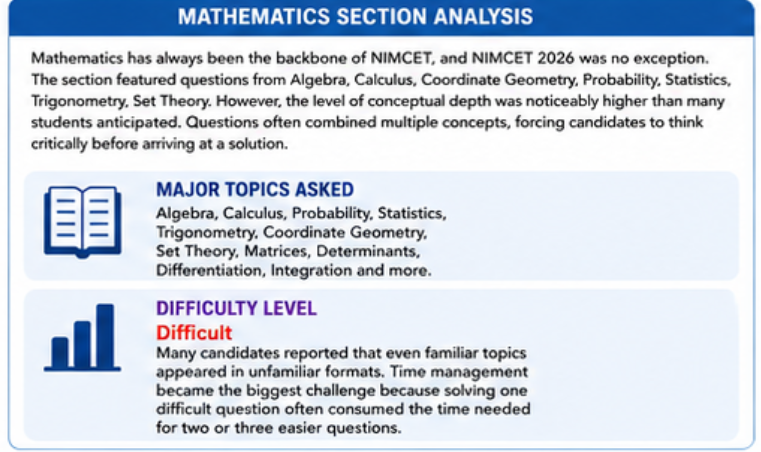
Mathematics has always been the backbone of NIMCET, and NIMCET 2026 was no exception. The section featured questions from Algebra, Calculus, Coordinate Geometry, Probability, Statistics, Trigonometry, Set Theory. However, the level of conceptual depth was noticeably higher than many students anticipated. Questions often combined multiple concepts, forcing candidates to think critically before arriving at a solution. Instead of direct formula application, many problems required interpretation, analysis, and multiple calculation steps. This increased both the solving time and the chances of making errors under pressure.
Major Topics Asked
The majority of Mathematics questions were distributed among Algebra, Calculus, Probability, Statistics, Trigonometry, Coordinate Geometry. Algebra and Calculus continued to dominate the section, contributing a significant share of the total questions. Topics such as matrices, determinants, differentiation, integration, and probability remained particularly important.
Difficulty Level of Mathematics
The Mathematics section can be classified as Difficult. Many candidates reported that even familiar topics appeared in unfamiliar formats. Time management became the biggest challenge because solving one difficult question often consumed the time needed for two or three easier questions. Candidates with strong conceptual understanding performed better than those relying primarily on memorization and shortcuts.
Logical Reasoning Section Analysis
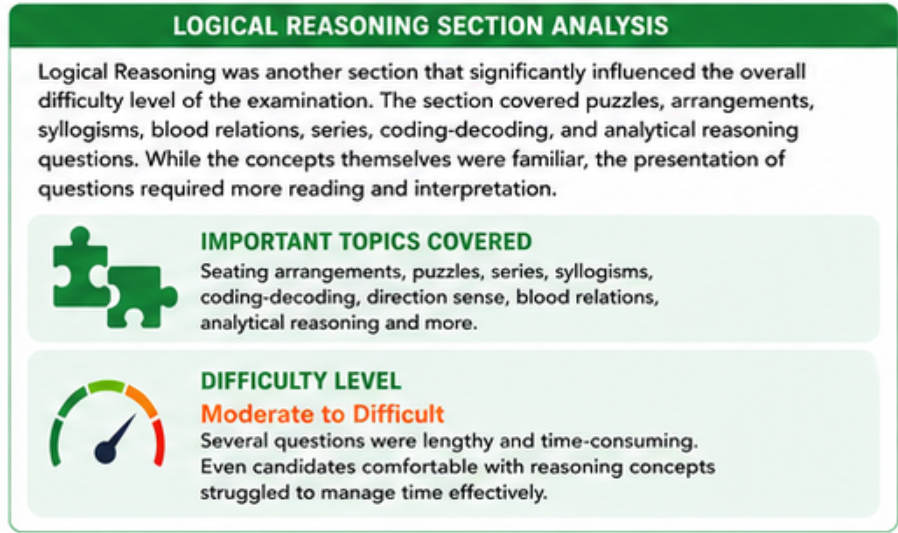
Logical Reasoning was another section that significantly influenced the overall difficulty level of the examination. The section covered puzzles, arrangements, syllogisms, blood relations, series, coding-decoding, and analytical reasoning questions. While the concepts themselves were familiar, the presentation of questions required more reading and interpretation.
Important Topics Covered
Candidates encountered seating arrangements, series-based questions, syllogisms, coding-decoding, direction sense, and blood relation problems. Puzzle-based questions occupied a substantial portion of the section and demanded careful attention to detail.
Difficulty Level of Reasoning
The Logical Reasoning section ranged from Moderate to Difficult. Students reported that several questions were lengthy and time-consuming. Even candidates who were comfortable with reasoning concepts struggled to maintain speed due to the complexity of the question statements. As a result, the average number of attempts was lower than expected for many aspirants.
Computer Awareness Section Analysis
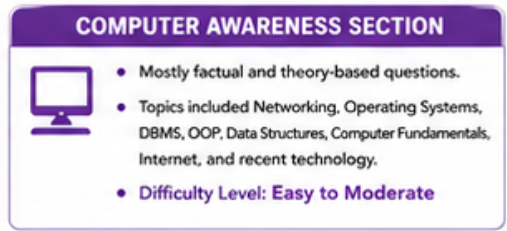
Computer Awareness once again proved to be the most scoring section of the examination. Candidates with basic computer science knowledge found this section highly manageable. Questions were largely theoretical and focused on core concepts rather than advanced technical knowledge.
Key Topics Asked
The section included Number System, Boolean Algebra, Logic Gates, Computer Architecture, Memory Management, and basic computer fundamentals. Most questions were direct and concept-based, making them relatively easy to solve.
Difficulty Level of Computer Awareness
The Computer Awareness section can be classified as Easy to Moderate. Candidates who regularly revised standard computer fundamentals were able to attempt a large majority of questions confidently. It emerged as one of the highest-scoring sections in NIMCET 2026.
English Section Analysis
Unlike previous years, the English section in NIMCET 2026 was not as straightforward as many students expected. While the number of questions remained limited, the section contained comparatively tougher vocabulary-based questions and a lengthy reading comprehension passage that required careful reading and interpretation. Candidates who relied only on basic grammar preparation found some questions challenging, particularly those related to advanced vocabulary and contextual word usage.
Topics Asked in English
The section included questions from Vocabulary, Synonyms, Antonyms, Sentence Correction, Grammar, Reading Comprehension, and Word Usage. Vocabulary-based questions carried a higher difficulty level than expected, and the reading comprehension passage was relatively lengthy, making time management important even in this section.
Difficulty Level of English
The English section can be classified as Moderate to Difficult. Many students reported that the vocabulary questions were tougher than previous years and required a strong command of word meanings and usage. The unseen passage was also comparatively lengthy, demanding additional reading time and concentration. Candidates with regular reading habits and a good vocabulary base performed better, while others found the section more challenging than anticipated.
Section-Wise Difficulty Comparison Table
Section | Difficulty Level |
Mathematics | Difficult |
Logical Reasoning | Moderate to Difficult |
Computer Awareness | Easy to Moderate |
English | Moderate to Difficult |
Expected Impact on Cutoff and Rank
Whenever an examination becomes more difficult, the average score of candidates tends to decrease. NIMCET 2026 appears to follow the same pattern. Since Mathematics and Logical Reasoning were tougher than expected, many students could not achieve their targeted attempts. This may lead to lower cutoff marks across several participating NITs. Candidates should remember that rank depends on relative performance rather than absolute marks. Therefore, even a score that appears lower than previous years may still result in a competitive rank if the overall paper difficulty was higher. The final cutoff trends will become clearer after counselling data is released, but current indications suggest a downward movement compared to easier examination years.
Score Range | Expected Admission Chances |
Above 400 Marks | High probability of securing a good rank and admission to top NITs participating in NIMCET counselling. |
310 – 380 Marks | Considered a good score range and may help candidates secure admission to better NITs with a competitive rank. |
250 – 310 Marks | Candidates may expect admission opportunities in lower-ranked NITs or in later counselling rounds, depending on seat availability and category. |
Below 250 Marks | Admission chances may become challenging, and candidates may need to rely on later rounds, special rounds, or alternative MCA colleges. |
Expected Category-Wise Score for NIT Admission (Tentative)-
General (Open) | EWS | OBC-NCL | SC | ST | PwD | |
NIT Tiruchirappalli (Trichy) | 335–350+ | 315–330 | 305–325 | 225–245 | 185–205 | 145–165 |
NIT Warangal | 310–330 | 290–310 | 285–300 | 200–220 | 165–180 | 125–140 |
MNNIT Allahabad | 295–315 | 275–290 | 265–285 | 180–195 | 140–160 | 110–125 |
NIT Kurukshetra (KKR) | 270–290 | 255–270 | 245–265 | 160–175 | 120–135 | 95–110 |
MANIT Bhopal | 265–285 | 250–265 | 240–255 | 155–170 | 115–130 | 90–105 |
NIT Jamshedpur | 260–280 | 245–260 | 235–250 | 150–165 | 110–125 | 85–100 |
NIT Delhi | 265–280 | 250–265 | 240–255 | 155–170 | 115–130 | 90–105 |
NIT Raipur | 240–255 | 225–240 | 220–235 | 130–145 | 95–110 | 75–85 |
NIT Patna | 230–245 | 215–230 | 210–225 | 120–135 | 85–100 | 65–75 |
NIT Agartala | 225–240 | 210–225 | 205–220 | 115–130 | 80–95 | 60–70 |
NIT Meghalaya | 220–235 | 205–220 | 195–210 | 110–125 | 75–90 | 55–65 |
Separate Matrix: Individual IIITs [1]
IIIT platforms consistently confirm lower closing thresholds than mid-tier NITs, serving as an excellent safety net for students with moderate marks.
Participating IIIT Institutes | General (Open) | EWS | OBC-NCL | SC | ST | PwD |
IIIT Bhopal | 210–220 | 200–210 | 190–205 | 100–115 | 70–85 | 55–65 |
IIIT Vadodara (Gandhinagar) | 205–215 | 195–205 | 185–200 | 95–110 | 65–80 | 50–60 |
IIIT Vadodara (Diu Campus) | 195–205 | 185–195 | 175–190 | 90–100 | 60–75 | 45–55 |
Separate Matrix: Self-Financing (SF) Seats Data
Because self-financing seats require a significantly higher fee structure, their raw marks cutoff drops noticeably compared to the regular seats at the same campus.
General (Open) | EWS | OBC-NCL | SC | ST | PwD | |
NIT Kurukshetra (SF Scheme) | 245–265 | 230–245 | 225–240 | 140–155 | 105–115 | 80–90 |
NIT Delhi (SF Scheme) | 250–260 | 235–245 | 230–245 | 145–155 | 110–120 | 85–95 |
NIT Patna (Data Science - SF) | 210–220 | 195–210 | 190–205 | 105–120 | 75–85 | 55–65 |
NIT Patna (AI & IoT - SF) | 215–225 | 200–215 | 195–210 | 110–125 | 80–90 | 60–70 |
What NIMCET 2027 Aspirants Should Learn
Preparation Strategy for Mathematics
Future aspirants should focus heavily on conceptual clarity rather than shortcut techniques. Daily practice of Algebra, Calculus, Probability, and Coordinate Geometry should become a priority. Solving previous-year papers and full-length mock tests under timed conditions will help develop both speed and accuracy.
Preparation Strategy for Reasoning
Reasoning preparation should include regular puzzle solving, arrangement questions, and analytical reasoning exercises. Students must learn to handle lengthy question statements efficiently while maintaining accuracy.
Preparation Strategy for Computer Awareness
Computer Awareness requires consistent revision of core computer science concepts. Number systems, logic gates, Boolean algebra, operating systems, and computer architecture should be revised frequently.
Preparation Strategy for English
Reading newspapers, improving vocabulary, and practicing grammar exercises can significantly improve English performance. Since the section is relatively easy, it should become a guaranteed scoring area for aspirants.
Conclusion
NIMCET 2026 proved to be a challenging examination that tested more than just academic knowledge. Mathematics emerged as the toughest section, while Logical Reasoning also demanded significant time and concentration. Computer Awareness and English provided valuable scoring opportunities for prepared candidates. The examination highlighted the growing importance of conceptual understanding, smart question selection, and effective time management. Students preparing for NIMCET 2027 should carefully study the trends observed in the 2026 paper and adjust their preparation strategy accordingly. Those who build strong fundamentals and practice extensively under exam conditions will be best positioned to achieve a top rank and secure admission to their desired NIT.

Frequently Asked Questions (FAQs)
1. What was the overall difficulty level of NIMCET 2026?
The overall difficulty level was Moderate to Difficult, with Mathematics being the toughest section.
2. Which section was the most difficult in NIMCET 2026?
Mathematics was widely regarded as the most difficult section by students and experts.
3. Which section was the easiest in NIMCET 2026?
General English was considered the easiest section, followed by Computer Awareness.
4. Did NIMCET 2026 have lengthy Logical Reasoning questions?
Yes, many candidates reported that the Logical Reasoning section contained lengthy and time-consuming questions.
5. How should NIMCET 2027 aspirants prepare after analyzing the 2026 paper?
Aspirants should focus on conceptual clarity, extensive mock test practice, strong Mathematics preparation, and effective time management skills.