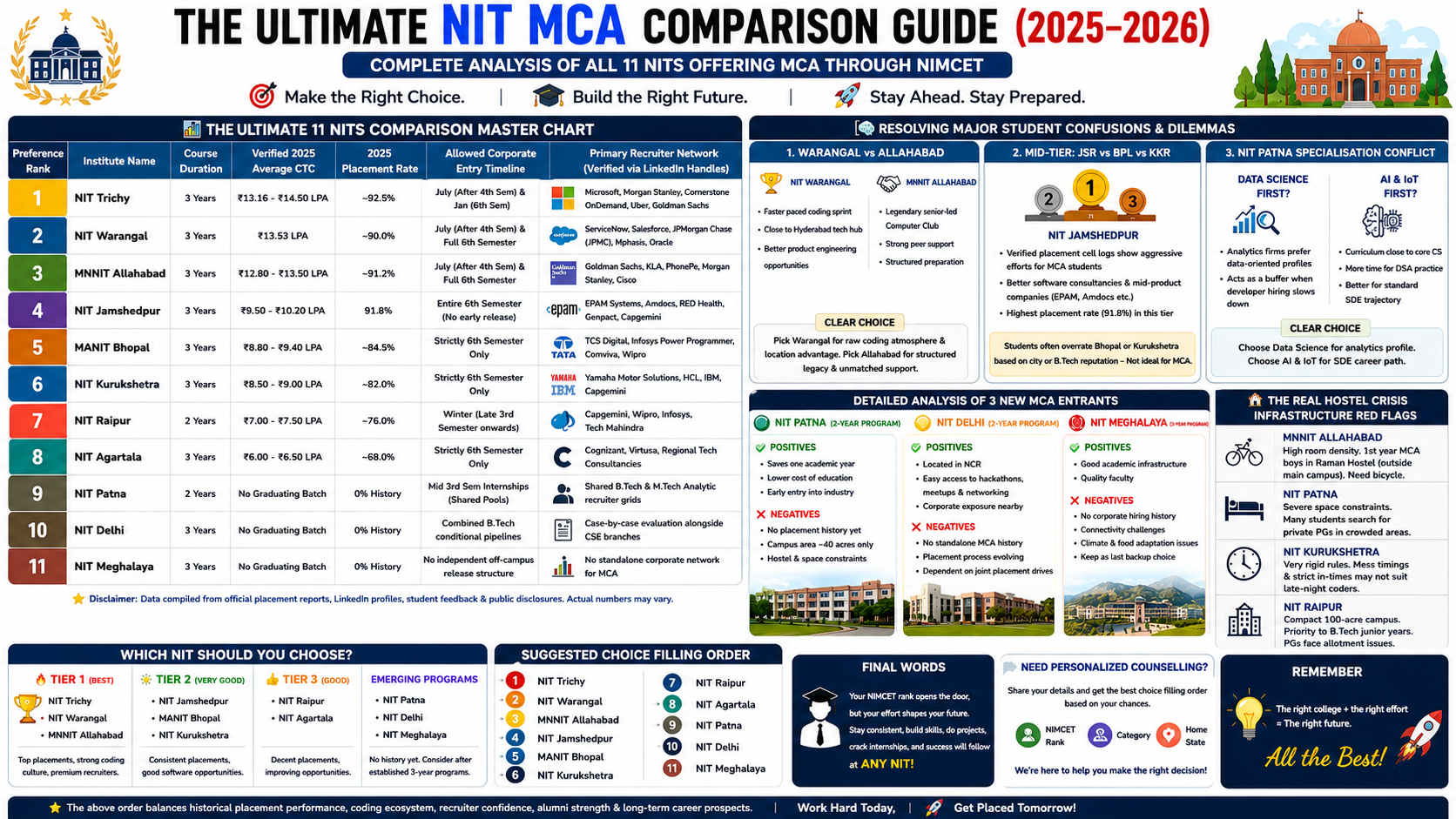
Jawaharlal Nehru University (JNU) is among the most sought-after destinations for MCA aspirants appearing in CUET PG. Every year, thousands of candidates compete for a limited number of MCA seats, making the admission process highly competitive.
One of the biggest misconceptions among students is that JNU directly uses the raw CUET PG score out of 300 for admission. In reality, JNU follows a structured merit preparation system that includes score normalization and deprivation point benefits before generating the final merit list.
In this article, we explain the complete JNU MCA admission process, score calculation formula, deprivation point system, historical cutoffs, and projected admission trends for 2026.
Understanding the JNU Merit Score System
Your CUET PG scorecard displays marks out of 300. However, JNU does not prepare its merit list directly from these raw marks.
Instead, JNU converts the CUET PG score into a 70-point scale and then adds eligible deprivation points.
The final merit list is prepared on a 100-point scale.
Official Merit Score Formula
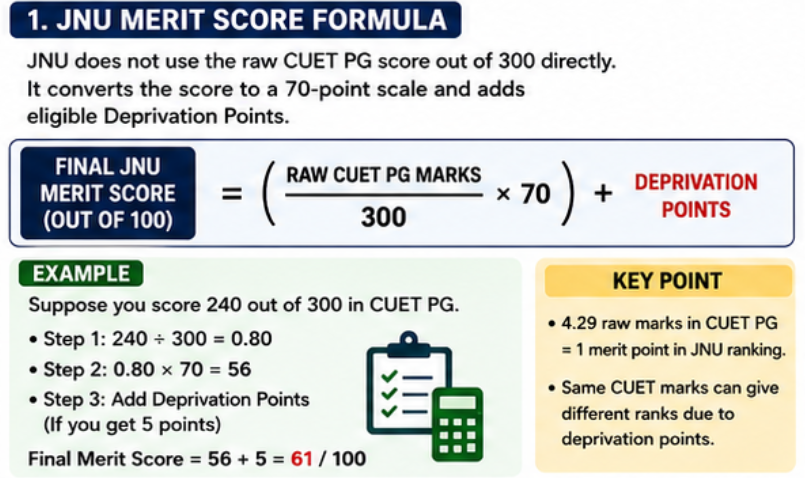
Final JNU Merit Score = (Raw CUET PG Marks ÷ 300 × 70) + Deprivation Points
Example
Suppose a candidate scores 240 marks out of 300.
Step 1:
240 ÷ 300 = 0.80
Step 2:
0.80 × 70 = 56
Step 3:
Add eligible deprivation points.
If the candidate receives 5 deprivation points:
Final Merit Score = 56 + 5 = 61
This score will be used for ranking during JNU admissions.
Why the JNU Merit Score Is Different from Raw CUET PG Marks
Many students compare only raw CUET PG scores and become confused when ranks differ significantly.
The reason is simple:
Score Compression
Since 300 marks are compressed into a 70-point scale:
Approximately 4.29 raw CUET PG marks become 1 merit point in JNU's ranking system.
As a result, small differences in raw scores may have a limited impact after scaling.
Impact of Deprivation Points
Two students with identical CUET PG marks can receive different ranks if one candidate is eligible for deprivation points.
This makes deprivation points a crucial factor in JNU admissions.
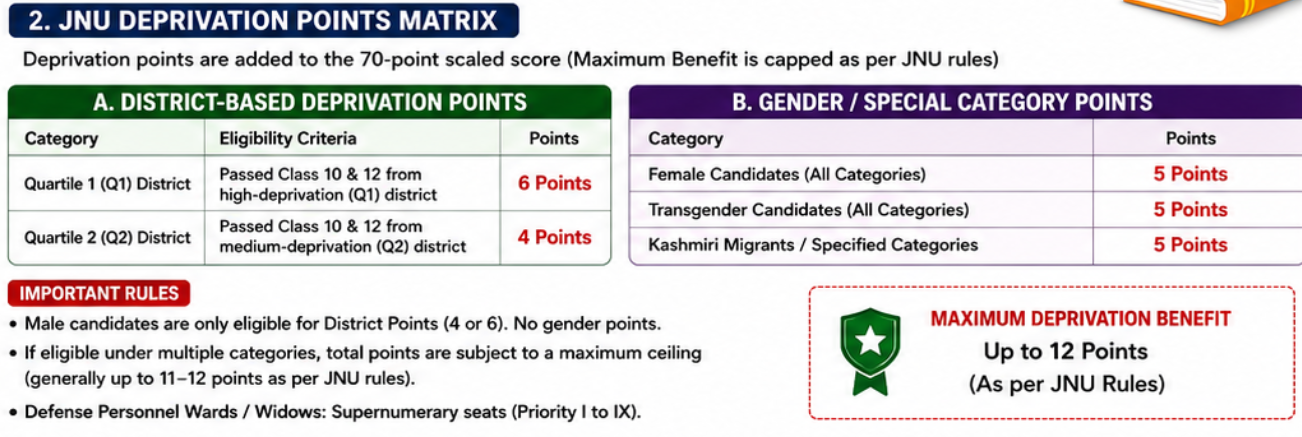
Complete JNU Deprivation Points Matrix
JNU provides deprivation benefits to candidates from educationally and geographically disadvantaged regions.
The maximum deprivation benefit is generally capped according to university regulations.
District-Based Deprivation Points
Category | Eligibility | Points |
Quartile 1 (Q1) District | Passed both Class 10 and Class 12 from an approved high-deprivation district | 6 Points |
Quartile 2 (Q2) District | Passed both Class 10 and Class 12 from an approved medium-deprivation district | 4 Points |
Gender-Based Deprivation Points
Category | Points |
Female Candidates | 5 Points |
Transgender Candidates | 5 Points |
Eligible Special Regional Categories | 5 Points |
Important Rules
Male Candidates
Male candidates are generally eligible only for district deprivation benefits.
They do not receive gender-based deprivation points.
Combined Ceiling Rule
If a candidate qualifies under multiple categories, the total deprivation benefit remains subject to the maximum ceiling prescribed by JNU.
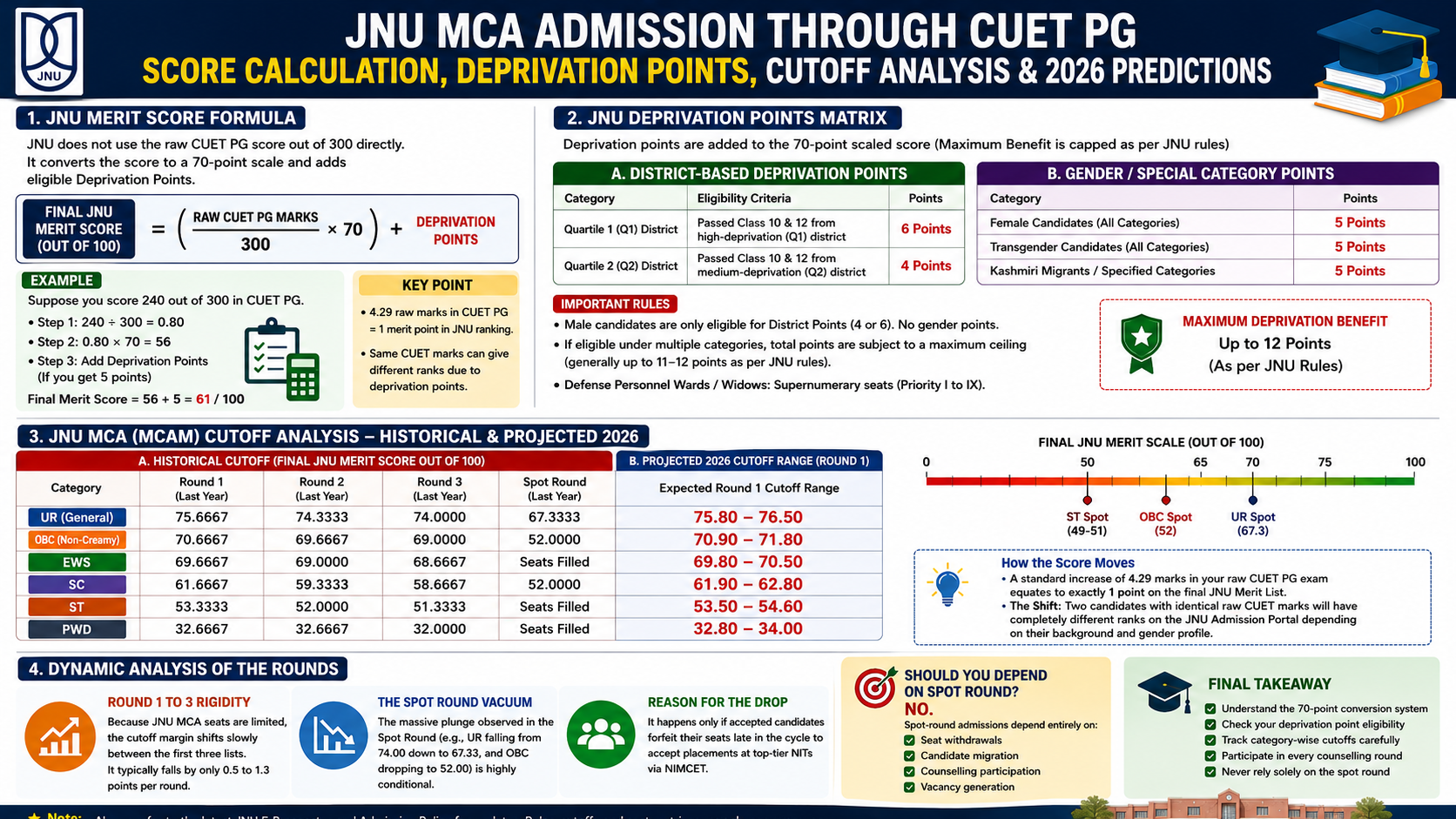
JNU MCA Historical Cutoff Analysis
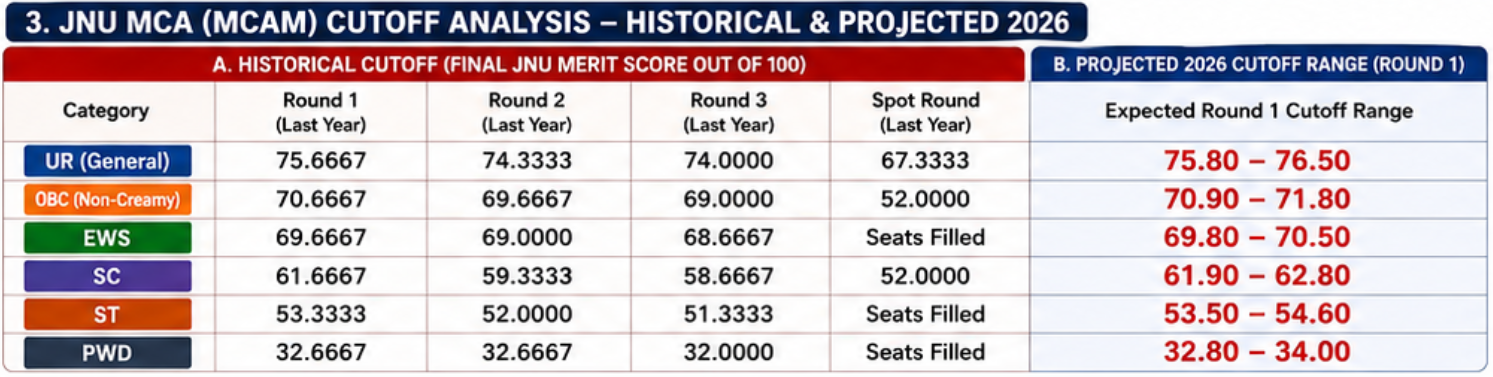
The following data highlights how JNU MCA cutoffs behaved across different counselling rounds.
General Category (UR)
Round | Cutoff |
Round 1 | 75.6667 |
Round 2 | 74.3333 |
Round 3 | 74.0000 |
Spot Round | 67.3333 |
OBC-NCL
Round | Cutoff |
Round 1 | 70.6667 |
Round 2 | 69.6667 |
Round 3 | 69.0000 |
Spot Round | 52.0000 |
EWS
Round | Cutoff |
Round 1 | 69.6667 |
Round 2 | 69.0000 |
Round 3 | 68.6667 |
SC
Round | Cutoff |
Round 1 | 61.6667 |
Round 2 | 59.3333 |
Round 3 | 58.6667 |
Spot Round | 52.0000 |
ST
Round | Cutoff |
Round 1 | 53.3333 |
Round 2 | 52.0000 |
Round 3 | 51.3333 |
PWD
Round | Cutoff |
Round 1 | 32.6667 |
Round 2 | 32.6667 |
Round 3 | 32.0000 |
Projected JNU MCA Cutoff 2026
Based on recent CUET PG competition levels, seat availability, counselling trends, and admission behavior, the expected Round-1 cutoffs may remain close to the following ranges.
Category | Expected Round-1 Cutoff Range |
UR | 75.80 – 76.50 |
OBC-NCL | 70.90 – 71.80 |
EWS | 69.80 – 70.50 |
SC | 61.90 – 62.80 |
ST | 53.50 – 54.60 |
PWD | 32.80 – 34.00 |
Understanding the Spot Round Phenomenon
One of the most discussed topics among CUET PG aspirants is the dramatic drop in JNU spot-round cutoffs.
For example:
UR dropped from approximately 74 to 67.
OBC dropped from approximately 69 to 52.
Many students assume this drop happens every year, but that is not always true.
Why Does the Spot Round Cutoff Fall?
The primary reason is seat withdrawal.
After securing admission in JNU, many high-ranking candidates later receive offers from:
NIT Trichy
NIT Warangal
NIT Surathkal
MNNIT Allahabad
Other NIMCET Participating NITs
When such candidates choose NITs over JNU and surrender their seats, vacancies arise, creating opportunities for lower-ranked candidates during the spot round.
Should You Depend on the Spot Round?
The answer is No.
Spot-round admissions depend entirely on:
Seat withdrawals
Candidate migration
Counselling participation
Vacancy generation
Therefore, aspirants should target Round 1 and Round 2 cutoffs rather than relying on spot-round opportunities.
Final Takeaway
JNU MCA admissions are determined not only by your CUET PG score but also by the university's merit score calculation process and deprivation point policy.
To maximize your chances:
✅ Understand the 70-point conversion system
✅ Check your deprivation point eligibility
✅ Track category-wise cutoffs carefully
✅ Participate in every counselling round
✅ Never rely solely on the spot round
A strong CUET PG score combined with a clear understanding of the JNU admission process can significantly improve your chances of securing a seat in one of India's most prestigious MCA programs.