Disclaimer: This analysis is entirely prediction-based and is prepared using historical admission trends, seat movement patterns, and upgrade behaviour observed in previous years. These are not official cutoffs. Only the cutoffs released by University of Delhi should be considered final. The university publishes admission-related information through its official admission portal.
DU M.Sc. Computer Science 2026: What to Expect in the Upcoming Rounds?
With the official Round 1 cutoff now available, the biggest question among aspirants is:
How much will the cutoff decrease in the upcoming rounds and spot rounds?
Every year, a significant number of students upgrade their choices or leave for other universities, creating opportunities for candidates with slightly lower scores.
Based on previous admission cycles, here is a detailed round-wise prediction.
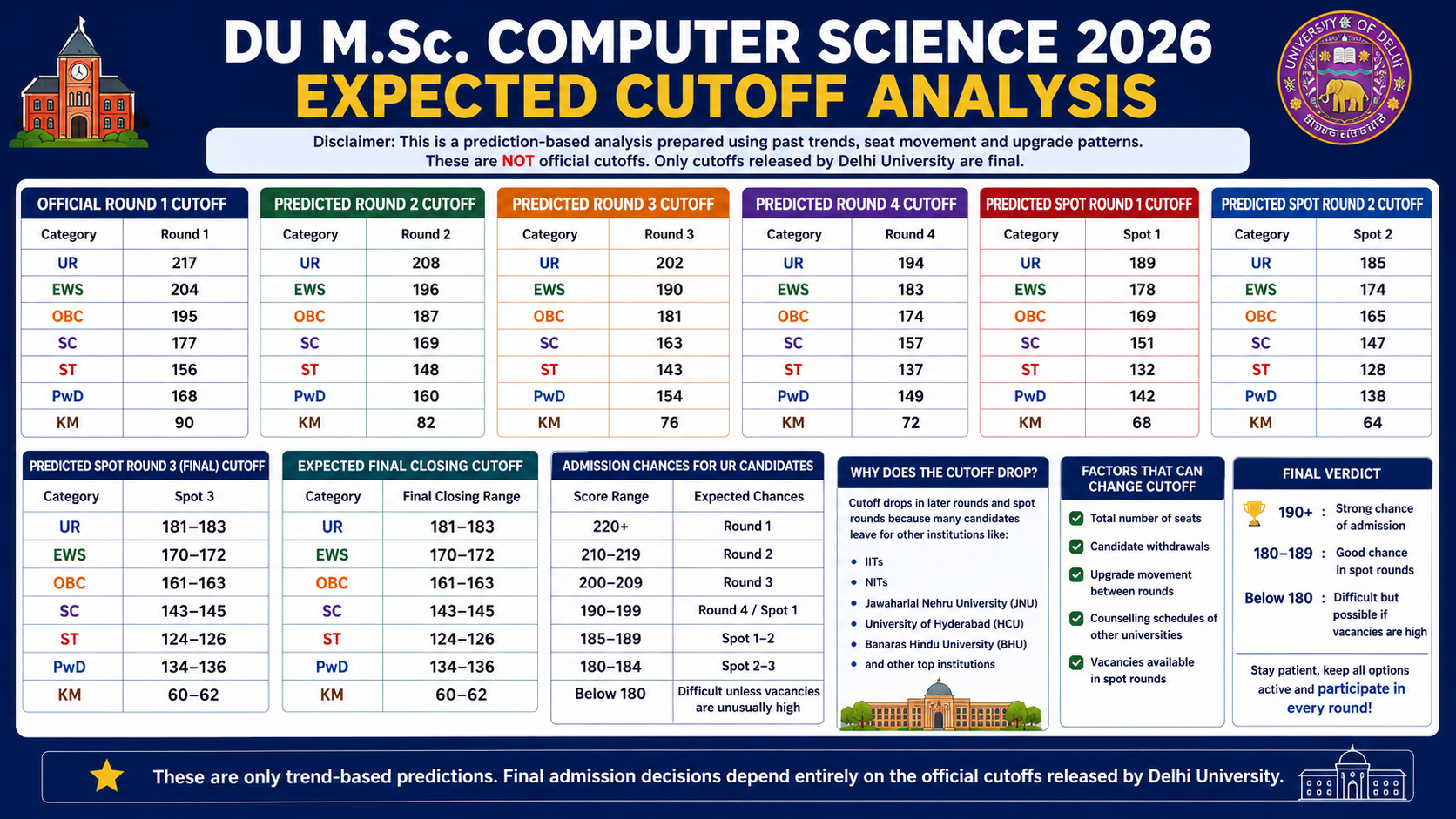
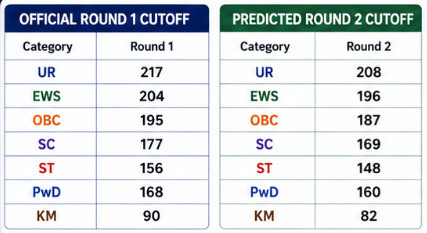
Official Round-1 (Department of Computer Science)
The official Round 1 cutoff for the Department of Computer Science is as follows:
Category | Round 1 |
UR | 217 |
EWS | 204 |
OBC | 195 |
SC | 177 |
ST | 156 |
PwD | 168 |
KM | 90 |
(From the screenshot you shared.)
Predicted Round 2
Historically, DU M.Sc. Computer Science cutoffs drop by around 6–10 marks in the second round due to seat upgrades and candidate withdrawals.
Category | Round 2 |
UR | 208 |
EWS | 196 |
OBC | 187 |
SC | 169 |
ST | 148 |
PwD | 160 |
KM | 82 |
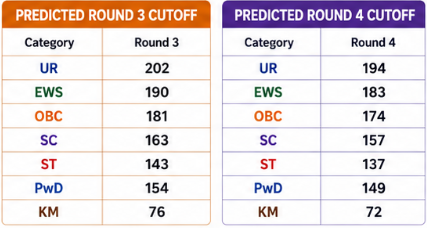
Predicted Round 3
By Round 3, additional seats usually become available as students secure admissions elsewhere.
Category | Round 3 |
UR | 202 |
EWS | 190 |
OBC | 181 |
SC | 163 |
ST | 143 |
PwD | 154 |
KM | 76 |
Predicted Round 4
By the fourth round, many high-scoring candidates have already finalized their admissions, allowing the cutoff to decrease further.
Category | Round 4 |
UR | 194 |
EWS | 183 |
OBC | 174 |
SC | 157 |
ST | 137 |
PwD | 149 |
KM | 72 |
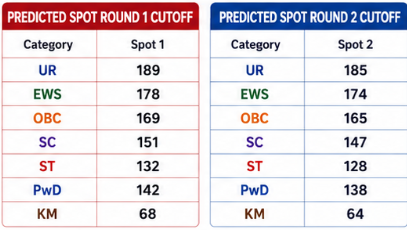
Predicted Spot Round 1
The biggest drop generally occurs during the spot rounds because many candidates leave for other prestigious institutions such as:
Indian Institutes of Technology (IITs)
National Institutes of Technology (NITs)
Jawaharlal Nehru University
University of Hyderabad
Banaras Hindu University
Category | Spot 1 |
UR | 189 |
EWS | 178 |
OBC | 169 |
SC | 151 |
ST | 132 |
PwD | 142 |
KM | 68 |
Predicted Spot Round 2
Category | Spot 2 |
UR | 185 |
EWS | 174 |
OBC | 165 |
SC | 147 |
ST | 128 |
PwD | 138 |
KM | 64 |
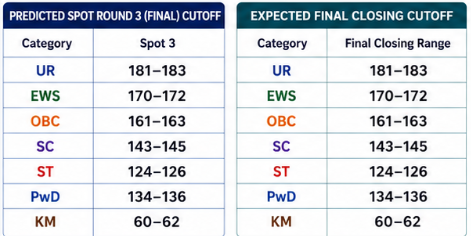
Predicted Spot Round 3 (Final)
This is expected to be the final admission phase where the remaining vacant seats are filled.
Category | Spot 3 |
UR | 181–183 |
EWS | 170–172 |
OBC | 161–163 |
SC | 143–145 |
ST | 124–126 |
PwD | 134–136 |
KM | 60–62 |
Expected Final Closing Cutoff
Based on the overall admission cycle, the expected final closing cutoff may look like this:
Category | Final Closing Range |
UR | 181–183 |
EWS | 170–172 |
OBC | 161–163 |
SC | 143–145 |
ST | 124–126 |
PwD | 134–136 |
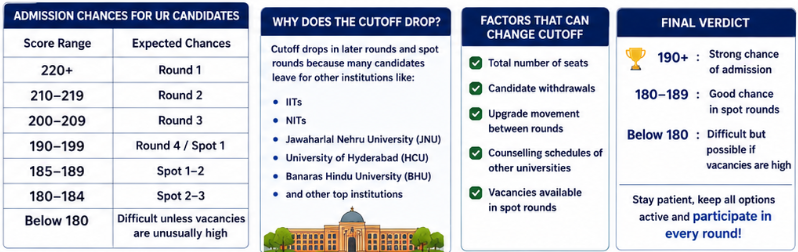
Admission Chances (UR)
Here is a rough estimate of admission possibilities based on scores.
Score | Chances |
220+ | Round 1 |
210–219 | Round 2 |
200–209 | Round 3 |
190–199 | Round 4 / Spot 1 |
185–189 | Spot 1–2 |
180–184 | Spot 2–3 |
Below 180 | Difficult unless vacancies are unusually high |
Factors That Can Change These Predictions
Several factors can significantly impact the final cutoff:
Total number of seats available.
Candidate withdrawals.
Upgrade movements between rounds.
Counselling schedules of other universities.
Number of vacant seats available during spot rounds.