The admission process for BHU MCA 2026 is expected to be highly competitive, especially for candidates seeking admission to the Department of Computer Science at the Main Campus. Every year, thousands of students compete for a limited number of seats, making cutoff trends an important factor for counselling strategy.
Based on previous admission patterns, seat availability, category-wise competition, and student migration to NITs, JNU, and DU, this article presents the expected BHU MCA 2026 cutoff matrix for all counselling rounds.
BHU MCA 2026 Counselling Overview
BHU offers MCA admissions through multiple categories and campuses:
Department of Computer Science (Main Campus – Regular Seats)
Department of Computer Science (Main Campus – Paid Seats)
Rajiv Gandhi South Campus, Barkachha (Special Fee Course)
The Main Campus Regular programme remains the most preferred choice among MCA aspirants, while the South Campus generally records lower closing scores due to seat upgrades and withdrawals.
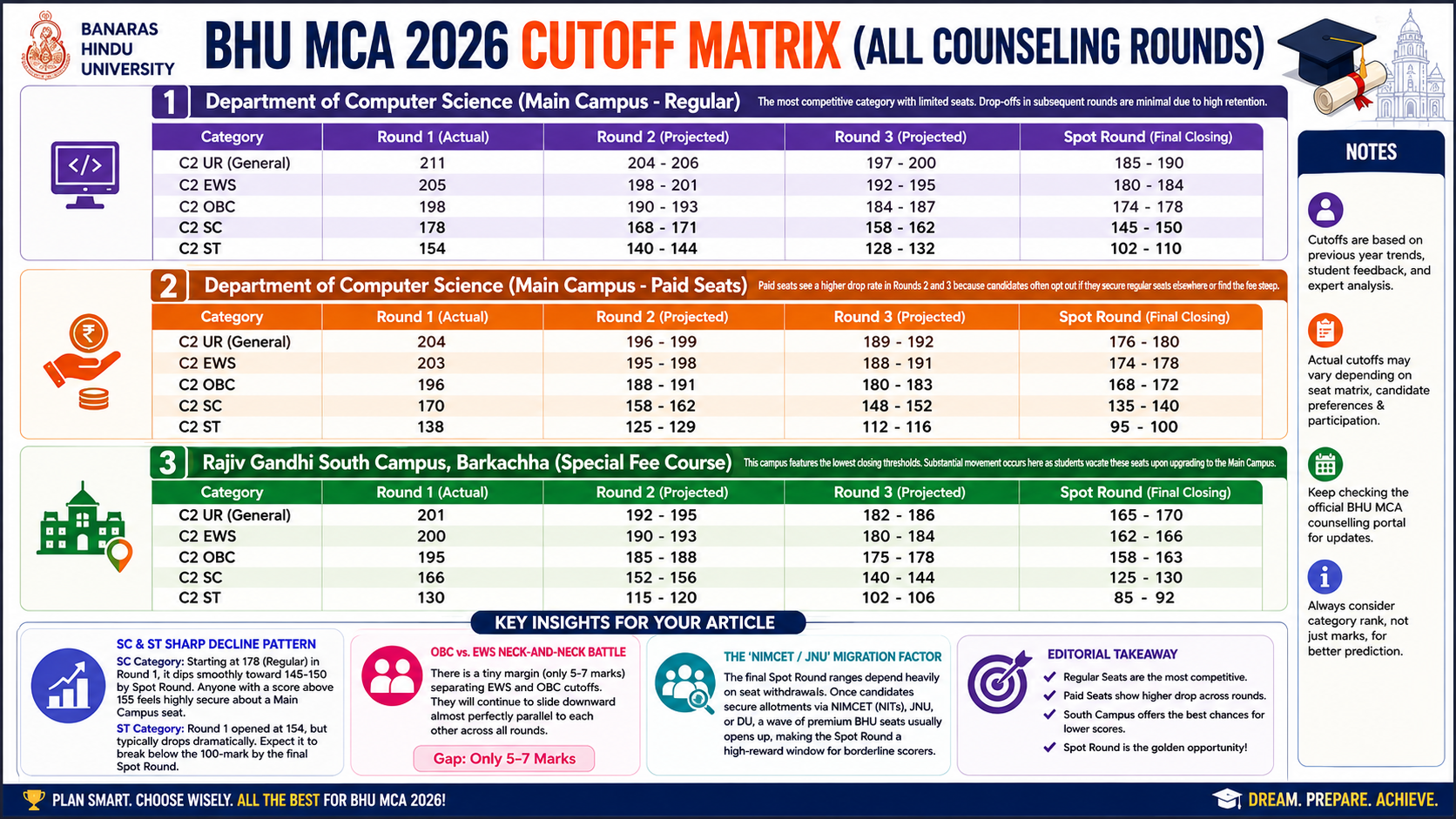
Department of Computer Science (Main Campus – Regular Seats)
This is the most competitive programme under BHU MCA admissions. Since students securing these seats rarely withdraw, cutoff reductions across rounds remain relatively small.
Category | Round 1 | Round 2 | Round 3 | Spot Round |
UR (General) | 211 | 204–206 | 197–200 | 185–190 |
EWS | 205 | 198–201 | 192–195 | 180–184 |
OBC | 198 | 190–193 | 184–187 | 174–178 |
SC | 178 | 168–171 | 158–162 | 145–150 |
ST | 154 | 140–144 | 128–132 | 102–110 |

Key Observation
Candidates scoring above 200 marks in the General category are expected to remain in a strong position for Main Campus admission. The competition remains intense throughout all rounds due to limited seat availability.
Department of Computer Science (Main Campus – Paid Seats)
Paid seats generally witness more movement during counselling because many candidates shift to regular seats at other institutions or decide against the higher fee structure.
Category | Round 1 | Round 2 | Round 3 | Spot Round |
UR (General) | 204 | 196–199 | 189–192 | 176–180 |
EWS | 203 | 195–198 | 188–191 | 174–178 |
OBC | 196 | 188–191 | 180–183 | 168–172 |
SC | 170 | 158–162 | 148–152 | 135–140 |
ST | 138 | 125–129 | 112–116 | 95–100 |

Key Observation
Students missing regular seats by a small margin often secure admission through paid seats during later counselling rounds.
Rajiv Gandhi South Campus (Special Fee Course)
The Rajiv Gandhi South Campus generally records the lowest cutoff scores among BHU MCA programmes. Significant seat movement occurs because many candidates upgrade to Main Campus seats whenever opportunities arise.
Category | Round 1 | Round 2 | Round 3 | Spot Round |
UR (General) | 201 | 192–195 | 182–186 | 165–170 |
EWS | 200 | 190–193 | 180–184 | 162–166 |
OBC | 195 | 185–188 | 175–178 | 158–163 |
SC | 166 | 152–156 | 140–144 | 125–130 |
ST | 130 | 115–120 | 102–106 | 85–92 |

Key Observation
Candidates with moderate scores often find the South Campus to be an excellent backup option while still obtaining a BHU degree.
Category-Wise Cutoff Trends
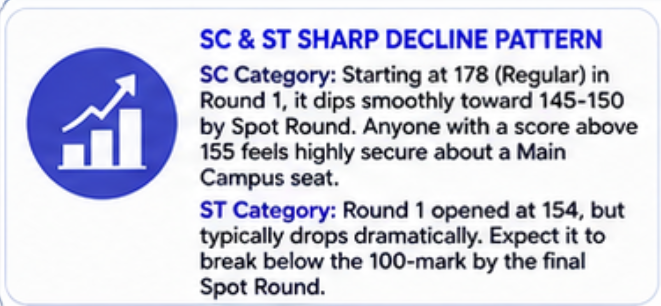
SC Category Analysis
The SC category is expected to witness a gradual decline across counselling rounds.
Round 1 starts around 178 marks.
Round 2 may close near 170 marks.
Round 3 could reach approximately 160 marks.
Spot Round is expected around 145–150 marks.
Candidates scoring 155+ marks are likely to remain in a favorable position for securing a Main Campus seat.
ST Category Analysis
The ST category generally shows the largest drop in cutoff scores.
Several factors contribute to this trend:
Limited number of applicants.
Smaller seat competition pool.
Higher seat vacancy rates during later rounds.
While Round 1 may begin near 154 marks, the final Spot Round could potentially close below 100 marks, similar to recent admission trends.
OBC vs EWS Competition
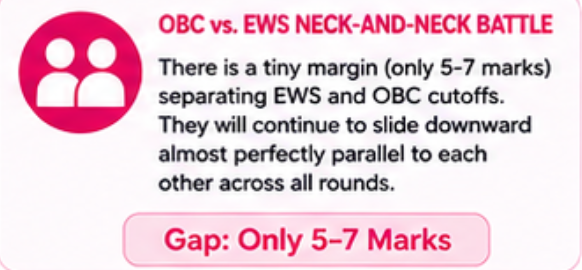
One of the most interesting observations is the close competition between OBC and EWS categories.
Throughout all counselling rounds:
The difference usually remains between 5–7 marks.
Both categories tend to move downward almost simultaneously.
Similar seat demand patterns keep their cutoffs closely aligned.
The NIMCET, JNU & DU Impact on BHU MCA Cutoffs
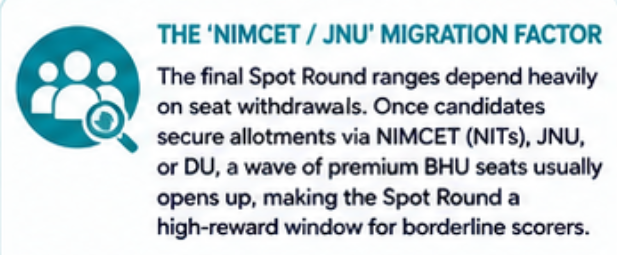
One of the biggest factors affecting BHU MCA spot round cutoffs is candidate migration.
Many top-ranking students simultaneously participate in admissions for:
NIT MCA programmes through NIMCET
JNU MCA
DU MCA
Other Central Universities
Once these candidates secure their preferred institutions, they often withdraw from BHU counselling, creating fresh vacancies.
This leads to significant cutoff drops during the Spot Round and opens opportunities for candidates who were previously outside the cutoff range.
Expected Safe Scores for BHU MCA 2026
Main Campus Regular
General: 205+
EWS: 200+
OBC: 192+
SC: 165+
ST: 140+
Main Campus Paid
General: 195+
EWS: 193+
OBC: 188+
SC: 155+
ST: 125+
Rajiv Gandhi South Campus
General: 190+
EWS: 188+
OBC: 182+
SC: 150+
ST: 115+
Final Verdict
BHU MCA 2026 admissions are expected to remain highly competitive, particularly for Main Campus Regular seats. However, counselling rounds and spot admissions can significantly improve opportunities for candidates with borderline scores.
Students should not lose hope after Round 1. Historically, substantial seat movement occurs due to withdrawals for NITs, JNU, DU, and other prestigious institutions. Candidates who remain active throughout all counselling rounds often secure admission despite initially missing the cutoff.
The Spot Round may once again become the most rewarding phase of BHU MCA 2026 counselling, especially for SC, ST, OBC, and borderline General category candidates.