

NIMCET 2007 — Reasoning PYQ
NIMCET | Reasoning | 2007Number of triangles and squares in the following figures:
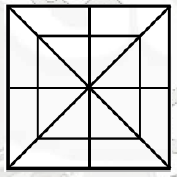
Choose the correct answer:
- A.
32 triangles, 10 squares
- B.
32 triangles, 8 squares
- C.
28 triangles, 10 squares
(Correct Answer) - D.
28 triangles, 8 squares
28 triangles, 10 squares
Explanation
1. Counting the Total Number of Squares
Let us break down the concentric structural design of the figure to count the squares first:
Outer Structure (Large Square Grid):
The main outer boundary forms a large square divided symmetrically by a horizontal and a vertical line through the center. This creates a standard 2×2 grid:
Small individual 1×1 squares = 4
Main large 2×2 boundary square = 1
Outer Squares=4+1=5
Inner Structure (Small Diamond Square):
Inside the main grid, there is an inner square tilted at an angle (appearing like a diamond grid) that connects the midpoints of the outer lines. This inner region is also divided symmetrically into four quarters:
Small individual 1×1 inner squares = 4
Main inner 2×2 boundary square = 1
Inner Squares=4+1=5
Total Squares:
Total Squares=5+5=10 squares
2. Counting the Total Number of Triangles
To count the triangles efficiently, we use the standard trick where a square cross-cut by both diagonals forms exactly 8 triangles (derived from 4 small individual triangles×2).
Triangles in the Inner Diamond Structure:
The inner tilted square has both diagonal lines passing completely through its center. Applying the standard counting shortcut for a diagonal-crossed square:
Inner Triangles=4×2=8
Triangles in the Outer Square Structure:
Now, look at the main outer square framework. It is also completely cut through by its two main diagonals, extending from corner to corner. Applying the same shortcut:
Outer Main Triangles=4×2=8
Triangles Formed by the Intersections (Middle Regions):
Let's look at the intermediate spaces created between the outer square perimeter and the inner diamond boundary lines. Each of the 4 main quadrants contains a group of smaller combined triangles:
In each corner/quadrant region, there are 2 small triangles sharing an edge.
Since there are 4 such regions around the symmetrical layout:
Intersection Triangles=4×3=12
Total Triangles:
Summing up all the discovered components:
Total Triangles=8+8=16 (from major bases)+12 (from intermediate lines)=28 triangles
Summary of Total Count
Number of Triangles: 28
Number of Squares: 10
This corresponds directly to the combination given in option (c).
Final Answer
The correct option is (c).